Polymyxins
Link to HTML slides
Link to recorded lecture
1 Introduction
The polymyxins — polymyxin B and polymyxin E (colistin) — are cyclic cationic lipopeptide antibiotics discovered in the late 1940s. Widely used through the 1960s, they were displaced by aminoglycosides and broad-spectrum β-lactams in the 1970s because of their toxicity. The resurgence of multidrug-resistant Gram-negative bacteria — particularly carbapenem-resistant Enterobacterales, Acinetobacter baumannii, and Pseudomonas aeruginosa — forced their return to clinical use in the 2000s. The reawakening prompted extensive pharmacokinetic re-investigation, which revealed that decades of clinicians had been under-dosing colistin and using the wrong drug for the wrong indications.
This document provides a written reference for the lecture, with sections paralleling the slide structure. The bibliography is rendered through the Diagnostic Microbiology and Infectious Disease CSL [1–3].
2 History
Polymyxins were independently described by Stansly, Benedict, and others in 1947, isolated from Paenibacillus polymyxa. Five variants (A–E) were initially characterized, but only polymyxin B and polymyxin E (later renamed colistin) advanced to clinical use. Widespread use through the 1960s gave way to abandonment in the 1970s as safer agents arrived. Carbapenem resistance dragged the class back; modern PK/PD studies have substantially revised dosing recommendations [4].
3 Chemistry and Mechanism
Polymyxins are cyclic decapeptides with a hydrophobic fatty acid tail (6-methyloctanoic or 6-methylheptanoic acid) and five positively charged α,γ-diaminobutyric acid (Dab) residues at physiologic pH. Polymyxin B and colistin differ by a single amino acid (D-phenylalanine in B vs. D-leucine in E) — a structurally minor distinction with major clinical implications.
Colistimethate sodium (CMS) is the inactive methanesulfonate prodrug of colistin, formed by reacting colistin with formaldehyde and sodium bisulfite to mask the cationic charge and reduce acute toxicity. CMS spontaneously hydrolyzes back to active colistin (and partially methanesulfonylated intermediates) in aqueous solution, including in plasma [5,6].
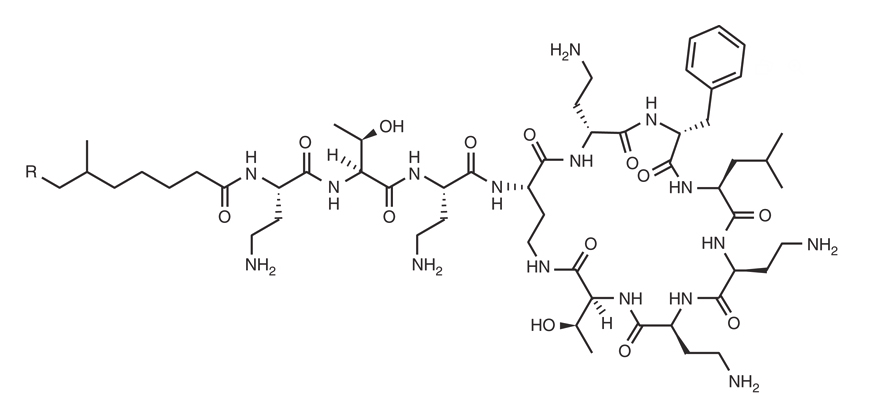
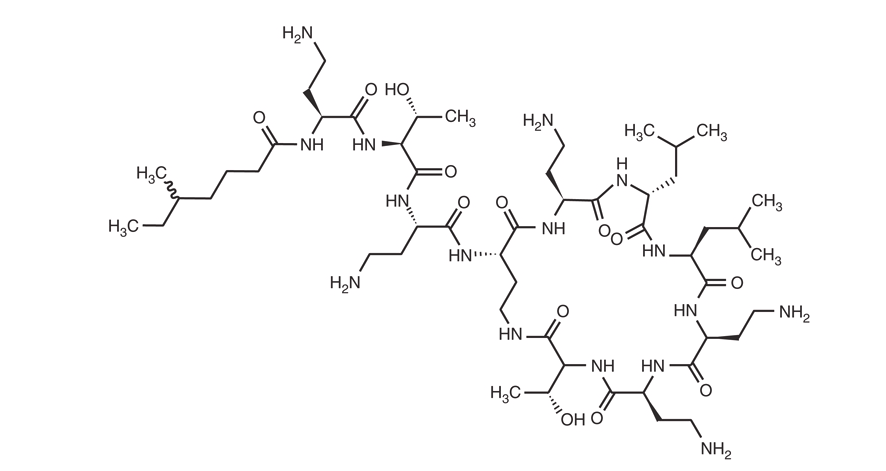
The cyclic peptide with multiple cationic Dab residues is the structural fingerprint of the class. The single–amino-acid difference between polymyxin B and colistin is biochemically trivial but pharmaceutically large — colistin is given as the prodrug CMS, polymyxin B as the active drug.
3.1 Mechanism of action
The cationic Dab residues bind negatively charged lipopolysaccharide (LPS) in the Gram-negative outer membrane, displacing the divalent cations (Ca²⁺, Mg²⁺) that bridge adjacent LPS molecules. The resulting membrane destabilization permits drug insertion into both outer and inner membranes, causing membrane permeabilization and cell death. Killing is bactericidal and concentration-dependent.
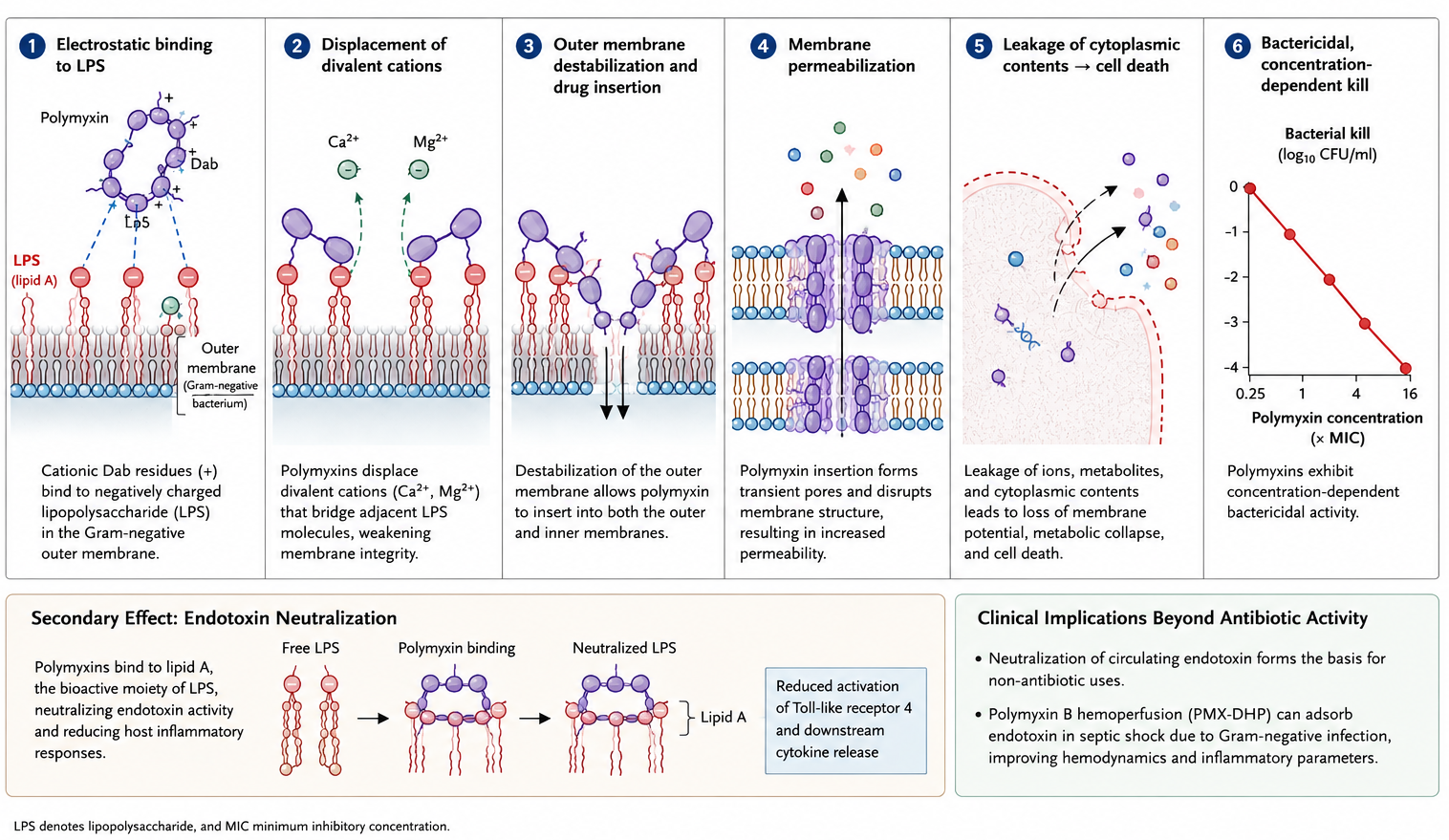
A secondary effect — binding of lipid A and neutralization of endotoxin — is the basis for non-antimicrobial uses such as polymyxin B hemoperfusion (Toraymyxin) in septic shock [7].
3.2 Spectrum
Polymyxins are active against most Gram-negative bacilli — E. coli, Klebsiella, Enterobacter, Salmonella, Shigella, Pseudomonas aeruginosa, Acinetobacter baumannii, with variable activity against Stenotrophomonas maltophilia.
Intrinsically resistant organisms include:
- Proteus, Providencia, Morganella, Serratia (lipid A modifications)
- Burkholderia cepacia complex
- All Gram-positive bacteria
- Anaerobes
- Neisseria, Brucella, Helicobacter
4 Resistance
Acquired polymyxin resistance arises through several mechanisms:
4.1 Lipid A modification
The dominant mechanism. Bacteria add 4-amino-4-deoxy-L-arabinose (L-Ara4N) and/or phosphoethanolamine (pEtN) to lipid A phosphate groups, neutralizing the negative charge polymyxins target. The modifications are regulated by the PmrAB and PhoPQ two-component systems, which sense environmental stress (low Mg²⁺, low pH, sub-MIC polymyxin exposure). Constitutive activation of these regulons through pmrB or phoQ mutation produces high-level resistance.
4.2 Plasmid-mediated mcr genes
In 2015, Liu and colleagues described mcr-1 in E. coli from Chinese livestock and humans — the first plasmid-mediated, horizontally transferable colistin resistance gene [3]. mcr-1 encodes a phosphoethanolamine transferase that modifies lipid A. By 2024, ten distinct mcr variants had been described; the genes have been identified globally and are frequently co-located with carbapenemase genes (NDM, OXA-48, KPC) on multiresistant plasmids [8–10].
| Year | Variant | First report | Notable feature |
|---|---|---|---|
| 2015 | mcr-1 | China, E. coli (livestock + human) | First plasmid-mediated colistin resistance |
| 2016 | mcr-2 | Belgium, E. coli | Variant on IncX4 plasmid |
| 2017 | mcr-3 | China, E. coli | High-prevalence emergence |
| 2017 | mcr-4 | Italy, Salmonella | First non-E. coli host |
| 2017 | mcr-5 | Germany, Salmonella | |
| 2018–24 | mcr-6 to mcr-10 | Global | Multiple host species |
4.3 Heteroresistance
Many A. baumannii and K. pneumoniae isolates show heteroresistance — apparent susceptibility on routine AST but containing a minority resistant subpopulation that can expand under polymyxin pressure. Heteroresistance partially explains the high rates of within-patient resistance emergence on polymyxin monotherapy observed in early cohort studies, and was a leading argument for combination therapy until trials clarified that combinations don’t actually improve outcomes [11,12].
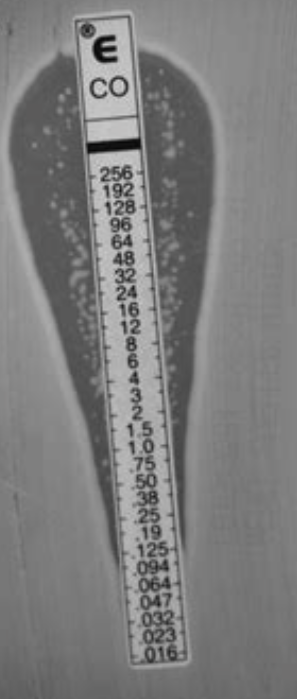
Heteroresistance is the part of the resistance story that a routine susceptibility report does not show: the culture returns susceptible, the patient receives monotherapy, and days later relapses with a fully resistant isolate. Population analysis profile (PAP) testing is the gold standard for detection but is not a routine method.
4.4 Susceptibility testing
Broth microdilution with polysorbate-80 is the only validated method; polymyxin adsorption to plastic plates produces falsely elevated MICs in standard panels. Disk diffusion and gradient strip methods perform poorly. The USCAST 2020 recommendation eliminated “susceptible” as a reportable category for polymyxins entirely, leaving only “intermediate” (MIC ≤ 2) and “resistant” (MIC ≥ 4) — an acknowledgment that even at low MICs, achievable plasma concentrations cannot reliably guarantee clinical efficacy [13].
5 Pharmacology
5.1 The CMS prodrug problem
Colistin is administered as colistimethate sodium (CMS), which is hydrolyzed in vivo to active colistin. Only approximately 30% of an administered CMS dose appears as colistin in blood; the rest is excreted unchanged by the kidney. This conversion is slow, with steady-state plasma colistin concentrations not reached for 2–3 days without a loading dose [6,14,15].
Polymyxin B is given as the active drug and has more predictable pharmacokinetics. Both drugs undergo extensive tubular reabsorption — leading to the nephrotoxicity problem that defines the class.
| Property | Polymyxin B | Colistin (as CMS) |
|---|---|---|
| Administered as | Active drug | Inactive prodrug (CMS) |
| Active species formation | Immediate | Slow hydrolysis to colistin in blood |
| Renal elimination | Mostly non-renal | Active drug ~70% non-renal; CMS ~70% renal |
| Renal dose adjustment | No (or minimal) | Yes (CMS, not colistin) |
| Urinary concentration | Low (not good for UTI) | High via CMS hydrolysis in urinary tract |
| PK predictability | Better | Worse (variable CMS conversion) |
The renal handling of the two drugs is opposite: colistin needs renal adjustment because most of the CMS prodrug is cleared by the kidney before it converts, whereas polymyxin B does not because it is given as active drug and cleared non-renally. The UTI exception runs the other way — colistin is preferred for UTI because CMS hydrolyzed in the urinary tract delivers active drug locally [6,14,15].
5.2 Dosing — colistin
The 2019 International Consensus Guidelines [1] recommend:
- Loading dose: 300 mg colistin base activity (CBA) IV over 30 minutes (equivalent to 9 million IU of CMS)
- Maintenance: total daily dose 300 mg CBA, divided q12h, adjusted for renal function per Nation 2017 [16]
- CRRT: 440 mg CBA/day in divided doses (continuous clearance increases requirements)
- HD: reduced dose with post-HD supplement on dialysis days
5.2.1 Renal adjustment for CMS
| CrCl (mL/min) | Total daily CMS (mg CBA) | Frequency |
|---|---|---|
| > 90 | 300 | divided q12h |
| 50–89 | 270 | divided q12h |
| 30–49 | 240 | divided q12h |
| 10–29 | 180 | divided q12h |
| < 10 (no HD) | 100 | once daily |
| HD | 60–80 + post-HD supplement | once daily + boost |
| CRRT | 440 | divided q8–12h |
5.3 Dosing — polymyxin B
- Loading dose: 2.0–2.5 mg/kg IV over 1 hour
- Maintenance: 1.25–1.5 mg/kg q12h
- No renal dose adjustment (non-renal clearance dominates)
5.4 Dosing unit confusion
CMS is sold variously in International Units (IU), milligrams of colistimethate sodium, and milligrams of colistin base activity (CBA). Approximate equivalence: 1 million IU CMS ≈ 80 mg CMS ≈ 30 mg CBA. Medication errors — including fatal under- and overdoses — have been attributed to unit conversion mistakes. The unit convention used by your institution’s label should be confirmed before any colistin order is prescribed or verified [17].
5.5 PK/PD targets
Polymyxins exhibit concentration-dependent killing with significant post-antibiotic effect; the relevant index is free drug AUC/MIC, with targets of approximately 12–20 for stasis or 1-log kill against most isolates. At standard doses against organisms with MIC at the breakpoint, the target may be unattainable safely — the therapeutic window between efficacy and nephrotoxicity is essentially zero [18–20].
5.6 Polymyxin B preferred for systemic infection
The 2019 Consensus Guidelines recommend polymyxin B over CMS for most systemic indications because of its more reliable pharmacokinetics and possibly lower nephrotoxicity. Exception: UTI, particularly upper UTI, where colistin (CMS) is preferred because urinary CMS hydrolysis delivers active colistin to the urinary tract — polymyxin B does not achieve adequate urinary concentrations [1].
6 Adverse Effects
6.1 Nephrotoxicity
Nephrotoxicity occurs in 30–60% of treated patients across modern cohort studies [21–25]. The mechanism involves megalin-mediated proximal tubular reabsorption and accumulation. Risk factors include higher cumulative dose, higher plasma levels (trough > 2.4 mg/L predicts AKI), baseline renal dysfunction, and concomitant nephrotoxins. AKI is usually reversible with discontinuation but is frequently dose-limiting.
Therapeutic window overlap. The plasma concentration required for activity against MIC 2 organisms (~2 mg/L) overlaps with the trough concentration associated with nephrotoxicity (~2.4 mg/L). This is the central pharmacologic problem of the class.
6.2 Trough-level monitoring
Therapeutic drug monitoring would help navigate this narrow window, but it is not routinely available in most clinical labs. Colistin assay requires LC-MS/MS with a turnaround of days rather than hours. The two relevant targets pull in opposite directions: a target trough ≤ 2.4 mg/L minimizes AKI risk [24], while a steady-state concentration ≥ 2 mg/L is needed for efficacy against an MIC 2 mg/L organism [6]. These targets overlap, so the therapeutic window is essentially zero. A few academic centers in Europe and the US offer TDM; most clinicians dose by weight and renal function alone.
6.3 Neurotoxicity
Paresthesias (perioral, peripheral) are common but usually mild and reversible. Ataxia, vertigo, and dizziness may occur. Neuromuscular blockade — a more serious effect — potentiates non-depolarizing blockers and has been reported to cause respiratory paralysis with high IV doses, particularly in patients with renal failure or concurrent neuromuscular disease.
6.4 Skin hyperpigmentation
A polymyxin B–specific adverse effect: diffuse darkening of the head, neck, and upper torso, with histology showing dermal melanophages. Onset is typically within the first weeks of therapy, with higher incidence in transplant patients; the change is reversible over months after discontinuation. The mechanism is poorly understood but may involve histamine release and inflammatory cytokine–driven melanocyte activation [26–28]. Counseling patients before initiation is appropriate.

7 Clinical Use
7.1 Indications
Polymyxins are considered for:
- Carbapenem-resistant Enterobacterales (CRE; KPC, NDM, OXA-48 producers) where newer β-lactam/inhibitors are unavailable or inactive
- Carbapenem-resistant A. baumannii (CRAB), with sulbactam-durlobactam and cefiderocol increasingly preferred where available
- Carbapenem-resistant P. aeruginosa (CRPA) — extensively-drug-resistant strains where newer agents are inactive
- Selected MDR Stenotrophomonas infections (TMP-SMX remains first-line)
- Empirical coverage for septic patients with prior MDR Gram-negative colonization
- Inhaled colistin as adjunct in ventilator-associated pneumonia or chronic P. aeruginosa colonization in CF
- Intrathecal/intraventricular CMS for CSF shunt infections [1]
- Selective decontamination of the digestive tract (SDD) in selected ICUs [29]
The hierarchy of preferred agents for each carbapenem-resistant pathogen is shifting rapidly as newer β-lactam/inhibitors and cefiderocol penetrate clinical practice; polymyxins are increasingly second- or third-line.
7.2 Carbapenem-Resistant Enterobacterales
For CRE, the modern β-lactam/inhibitor combinations — ceftazidime-avibactam (KPC, OXA-48), meropenem-vaborbactam (KPC), imipenem-relebactam (KPC), and ceftazidime-avibactam + aztreonam or cefiderocol (NDM) — have largely displaced polymyxins as first-line. Polymyxin role is now salvage when newer agents are inactive (e.g., emergent ceftazidime-avibactam resistance in KPC-3 variants) or unavailable.
7.3 Carbapenem-Resistant A. baumannii
Historically: colistin ± meropenem ± tigecycline ± ampicillin-sulbactam, often with substantial uncertainty about which combination is best. The 2023 FDA approval of sulbactam-durlobactam based on the ATTACK trial — which demonstrated non-inferior efficacy and substantially less nephrotoxicity vs. colistin — established the new first-line for CRAB where it is available [30–33]. High-dose ampicillin-sulbactam and cefiderocol have residual roles; polymyxin remains the default where sulbactam-durlobactam is not on the formulary.
7.4 Carbapenem-Resistant P. aeruginosa
Ceftolozane-tazobactam (where the resistance mechanism is not carbapenemase-mediated), ceftazidime-avibactam, imipenem-relebactam, and cefiderocol have largely replaced polymyxins as first-line for CRPA. Polymyxin is reserved for XDR isolates resistant to all of the above, often in combination [34].
7.5 No oral step-down
Polymyxins are essentially non-absorbed when given orally, so there is no oral step-down option. Once IV polymyxin therapy is started, the patient remains on IV until completion. This has practical consequences: long courses require sustained IV access, outpatient parenteral therapy (OPAT) is possible but demands multiple daily infusions plus safety monitoring, and duration decisions should weigh the IV-access burden. A patient with KPC bacteremia who improves clinically on day 5 still needs the remaining IV days — there is no oral exit. This distinguishes polymyxins from many other Gram-negative–active agents (fluoroquinolones, TMP-SMX, doxycycline, oral fosfomycin) where step-down is feasible.
7.6 Cefiderocol
Cefiderocol is a catechol siderophore cephalosporin whose siderophore moiety hijacks bacterial iron transport (TonB-dependent receptors), bypassing outer membrane permeability barriers. It is active against most CRE (including NDM), CRPA, CRAB, and Stenotrophomonas. In APEKS-NP (Wunderink 2021) it was non-inferior to high-dose meropenem in nosocomial pneumonia, but in CREDIBLE-CR (Bassetti 2021) mortality was numerically higher in the cefiderocol arm versus best available therapy — an unexplained signal that made some centers cautious. Where available and active, it is generally preferred over polymyxin for severe MDR Gram-negative infection.
8 Combination Therapy
In vitro synergy between colistin and many partner agents (carbapenems, rifampin, tigecycline, fosfomycin) has been demonstrated extensively, particularly against Acinetobacter [18,35,36]. Two large RCTs have since clarified the clinical picture:
- AIDA (Paul 2018): 406-patient open-label RCT of colistin alone vs. colistin + meropenem for serious CR-Gram-negative infection (predominantly CRAB). No difference in clinical failure at 14 days, no difference in 28-day mortality, more nephrotoxicity in the combination arm [37].
- Kaye 2023 (NEJM Evidence): 464-patient multicenter RCT of colistin alone vs. colistin + meropenem for CR-Gram-negative infection (predominantly CRAB). Same conclusion — no efficacy benefit, more nephrotoxicity in combination [38].
Both trials concentrated on CRAB and on colistin + carbapenem combinations specifically. The findings do not exclude every possible combination benefit (e.g., colistin + ceftazidime-avibactam for KPC bacteremia in salvage settings), but they have firmly displaced routine combination therapy as the default approach. The modern posture: use a polymyxin alone unless a specific reason exists to combine.
9 Inhaled and Intrathecal Routes
9.1 Inhaled colistin
Aerosolized CMS via vibrating-mesh or jet nebulizer is used in:
- Cystic fibrosis with chronic P. aeruginosa colonization — well-established efficacy [39]
- Ventilator-associated pneumonia caused by MDR Gram-negatives — adjunctive use; benefits modest in trials [40]
Dosing for CF (EMA package insert): 1–2 MIU (33–66 mg CBA) three times daily for patients ≥ 2 years. For VAP adjunct, 75–150 mg CBA q12h is commonly used though formal recommendations are scarce. CMS should be premixed only immediately before nebulization — formed colistin in standing solution causes bronchoconstriction and increases toxicity.
9.2 Intrathecal / intraventricular CMS
For CSF shunt and external ventricular drain infections with MDR Gram-negative pathogens, intraventricular CMS at 125,000 IU (4.1 mg CBA) daily is the consensus recommendation [1]. Polymyxin B 5–10 mg intrathecally has also been used. Aseptic chemical ventriculitis (fever, CSF pleocytosis without infection) can complicate intraventricular therapy.
10 Other Considerations
10.1 Selective Decontamination of the Digestive Tract
Combined oropharyngeal and gut decontamination with polymyxin + tobramycin + amphotericin B reduced ICU mortality in a Dutch RCT (de Smet 2009) [29]. Subsequent international trials have shown more modest effects. Adoption remains uneven — common in Dutch and German ICUs, controversial in the US, partly because of concerns about driving resistance.
10.2 Polymyxin B hemoperfusion
Polymyxin B–immobilized fiber columns (Toraymyxin / PMX-DHP) bind circulating endotoxin and are used in Japan and parts of Europe for endotoxic septic shock. The EUPHRATES trial (Dellinger 2018, JAMA) failed its primary endpoint; a post-hoc subgroup of patients with intermediate endotoxin activity (0.6–0.9) suggested possible benefit. The technique is not routinely used in US ICUs. It is conceptually distinct from IV polymyxin therapy — mechanism is endotoxin neutralization, with no antimicrobial effect on the patient’s flora.
11 2026 Snapshot
| Pathogen | First-line (where available) | Polymyxin role |
|---|---|---|
| KPC | Meropenem-vaborbactam, ceftazidime-avibactam, imipenem-relebactam | Salvage |
| NDM | Ceftazidime-avibactam + aztreonam, cefiderocol | Salvage |
| OXA-48 | Ceftazidime-avibactam | Salvage |
| CRAB | Sulbactam-durlobactam, cefiderocol | Adjunct / where SUL-DUR unavailable |
| CRPA | Ceftolozane-tazobactam, ceftazidime-avibactam, imipenem-relebactam, cefiderocol | Salvage; inhaled adjunct |
| CR UTI | Colistin (CMS) | First-line by route |
11.1 Choosing between polymyxin B and CMS
When a polymyxin is required, the choice between polymyxin B and CMS follows the pharmacology: polymyxin B for most systemic infection, CMS where local urinary or CSF delivery matters.
| Clinical scenario | Preferred agent | Why |
|---|---|---|
| CRE bacteremia | Polymyxin B | Faster, more predictable plasma concentrations |
| CRAB pneumonia (SUL-DUR unavailable) | Polymyxin B ± inhaled colistin | Better PK predictability |
| CR-Pseudomonas catheter-related BSI | Polymyxin B | Non-renal clearance; line management dominates |
| Lower UTI / cystitis | Colistin (CMS) | Urinary CMS hydrolysis delivers active drug locally |
| CSF shunt infection | Intraventricular CMS | Direct administration; polymyxin B not standardized intrathecally |
| CRRT patient | Either; polymyxin B simpler | Avoids CMS-conversion variability |
11.2 Italian epidemiology
Italy and Greece have historically reported the highest CRAB rates in Europe (exceeding 80% of Acinetobacter isolates in some surveys), and KPC-producing K. pneumoniae has been dispersed across Italian ICUs since the mid-2010s. Colistin remained the default agent through the late 2010s. Recent uptake of ceftazidime-avibactam, meropenem-vaborbactam, and cefiderocol has reduced — but not eliminated — polymyxin use, and mcr genes have been documented in both Italian livestock and clinical isolates. This local burden is why polymyxin pharmacology remains front-of-mind in Italian ICUs.
12 Key Teaching Points
- CMS is an inactive prodrug; conversion to active colistin is slow and incomplete (~30%).
- Polymyxin B is given as active drug — more predictable PK, no renal adjustment, preferred for systemic infection.
- Loading dose is mandatory in critically ill patients receiving CMS (300 mg CBA IV, or weight-based 5 mg/kg). Without it, the first 48 hours are subtherapeutic.
- Unit confusion (IU vs. mg CMS vs. mg CBA) has killed patients. Always specify the unit on the order.
- Nephrotoxicity rates are 30–60% in modern cohorts; therapeutic and toxic plasma concentrations overlap.
- Polymyxin B causes diffuse hyperpigmentation — counsel patients before initiation.
- AIDA (2018) and Kaye (2023): colistin + meropenem does not improve outcomes vs. colistin alone for CR-Gram-negatives, and adds nephrotoxicity. Combination therapy should not be reflexive.
- Use polymyxin B for systemic infection; use CMS for UTI.
- In 2026, polymyxins are reserve agents. When a newer β-lactam/inhibitor (ceftazidime-avibactam, meropenem-vaborbactam, imipenem-relebactam, sulbactam-durlobactam) or cefiderocol is active and available, prefer that agent.
- You cannot step down to oral — polymyxins are essentially non-absorbed orally. Commit IV access for the full duration.