Cephalosporins and Cephalosporin/β-Lactamase Inhibitor Combinations

Cephalosporins and
Cephalosporin-β-Lactamase Inhibitors


Russell E. Lewis
Associate Professor of Infectious Diseases
Department of Molecular Medicine
University of Padua


russelledward.lewis@unipd.it
https://github.com/Russlewisbo
Slides and course materials: www.idpadova.com

Learning objectives


After this presentation, you will be able to:

  1. Describe the structure and mechanism of action of cephalosporins
  2. Classify cephalosporins by generation and spectrum
  3. Compare pharmacokinetic properties across generations
  4. Select appropriate cephalosporins for common infections
  5. Recognize important adverse effects and drug interactions
  6. Apply knowledge of β-lactamase inhibitor combinations

Historical Overview

Discovery of cephalosporins:
From Sardinian sewage to modern medicine

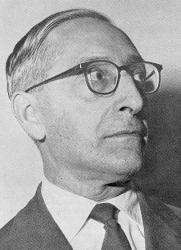
1945: Giuseppe Brotzu discovers antimicrobial activity

  • Epidemiologist working in Sardinia, Italy
  • Isolated Cephalosporin acremonium from sewage outflow
  • Demonstrated activity of filtrate against gram-positive AND gram-negative bacteria
  • Could not find resources from Italian government to develop antibiotic- sent to UK where cephalosporin C was isolated in the 1950s

Amazing fact

Brotzu noticed that locals who swam near sewage outfalls rarely developed typhoid fever, leading to his investigation. It took almost two decades from discovery to clinical use (1964)!

Development timeline


Year Milestone
1945 Brotzu discovers cephalosporin-producing mold
1950s Florey & Abraham isolate cephalosporin C at Oxford
1964 Cephalothin - first clinical cephalosporin
1970s Second-generation cephalosporins
1980s Third-generation (ceftriaxone, ceftazidime)
2000s Fourth and fifth generation
2010s β-lactamase inhibitor combinations

Why cephalosporins matter today


>20 cephalosporins in clinical use

Among the most widely prescribed antibiotic class due to:

  • Broad spectrum of activity
  • Low toxicity profile
  • Ease of administration
  • Favorable pharmacokinetics
  • Multiple routes (IV, IM, PO)

Chemistry & Structure

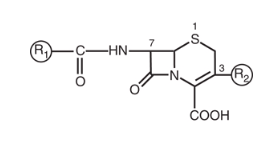
Basic cephem nucleus


Core structure:

  • β-lactam ring fused to a 6-member dihydrothiazine ring
  • Starting material: 7-aminocephalosporanic acid (7-ACA)

Key difference from penicillins:

  • Penicillin: 5-member thiazolidine ring
  • Cephalosporin: 6-member dihydrothiazine ring

Structure-activity relationships


Two key modification sites:

Position Common Name Effect on Drug
C7 (acyl side) R1 Spectrum of activity; β-lactamase stability
C3 R2 Pharmacokinetics; Half-life; CNS penetration

Remember

R1 = Microbiology; R2 = Pharmacology

R1 Modifications: Enhancing spectrum


α-Carbon modifications at C7:

  • Hydroxyl group → Enhanced gram-negative (cefuroxime)
  • Methoxyimino group → 3rd generation spectrum
  • 2-Aminothiazol group → 3rd/4th generation potency

Cephamycins

  • Methoxy substitution at C7 → Cefoxitin, Cefotetan

  • Enhanced anaerobic coverage

  • Resistance to many β-lactamases

  • BUT: Reduced gram-positive activity

R2 Modifications: Changing pharmacology


Modification Effect Example
Acetoxy side chain Short half-life Cephalothin
Thiomethyl heterocycle Long half-life, biliary excretion Ceftriaxone
Quaternary ammonium Zwitterion, better GN penetration Cefepime


MTT side chain warning

Methylthiotetrazole (MTT) at R2:

  • Coagulation abnormalities (vitamin K antagonism)
  • Disulfiram-like reactions

Found in: Cefamandole, Cefotetan, Cefoperazone

Mechanism of Action

PBP inhibition


All β-lactams share the same mechanism:

  1. β-lactam ring mimics D-Ala-D-Ala terminus
  2. Binds to penicillin-binding proteins (PBPs)
  3. Inhibits transpeptidase activity
  4. Prevents peptidoglycan cross-linking
  5. Cell wall weakens → Osmotic lysis → Cell death


Pharmacodynamic properties


Key Concept: Time-dependent killing

Cephalosporin efficacy correlates with T>MIC (Time drug concentration remains above MIC)


Target: T>MIC of 60-70% of dosing interval

Clinical implications:

  • More frequent dosing OR
  • Extended/continuous infusions
  • Especially important for serious infections

Classification by Generation

Overview of generations


Generation Gram-Positive Gram-Negative Special Features
1st ++++ + MSSA, strep
2nd +++ ++ Some anaerobes
3rd ++ +++ CNS penetration
4th +++ ++++ Pseudomonas
5th ++++ (MRSA) ++ Anti-MRSA


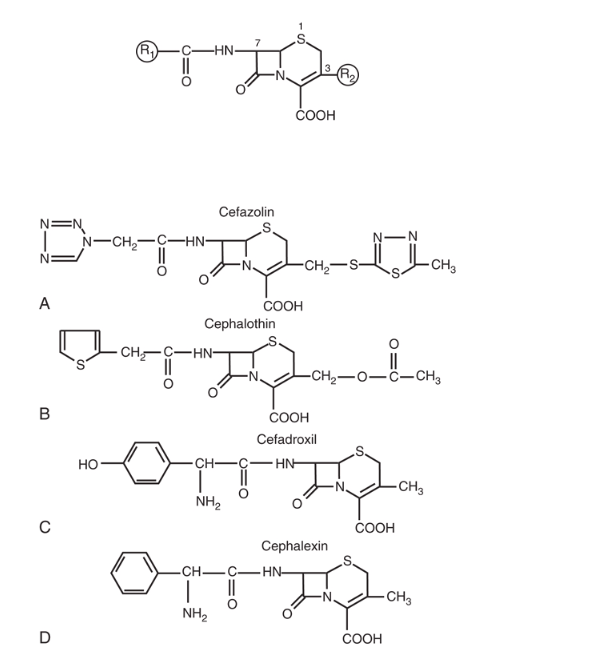
First generation cephalosporins


Available agents:

  • IV: Cefazolin (workhorse)
  • PO: Cephalexin, Cefadroxil

Spectrum:

  • Excellent: MSSA, Streptococci
  • Moderate: Some Enterobacterales
  • Poor: H. influenzae, M. catarrhalis, anaerobes

Clinical pearl

Cefazolin is the #1 drug for surgical prophylaxis

First generation: Clinical uses


Primary indications:

  1. Surgical prophylaxis (cefazolin)

    • Cardiac, vascular, orthopedic surgery
    • Clean procedures
  2. Skin/soft tissue infections

    • Cellulitis, erysipelas
    • MSSA abscesses
  3. MSSA bacteremia (cefazolin now preferred to oxacillin/nafcillin because of reduced nephrotoxicity)

  4. Streptococcal pharyngitis (oral agents)

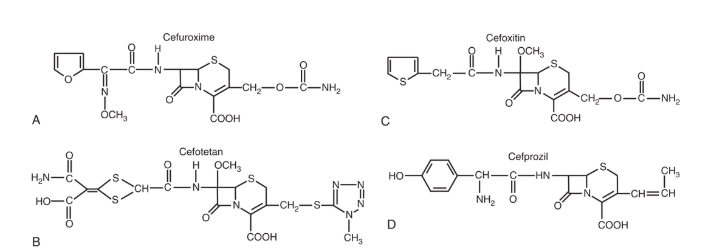
Second generation cephalosporins

Available agents:

  • IV: Cefuroxime, Cefoxitin, Cefotetan
  • PO: Cefuroxime axetil, Cefaclor, Cefprozil


Enhanced coverage:

  • Better H. influenzae activity

  • Cephamycins: Bacteroides fragilis coverage


Second generation: Cephamycin focus


Cefoxitin & Cefotetan

Unique features:

  • α-Methoxy group at C7
  • Activity against B. fragilis (50-80%)
  • Useful for intra-abdominal infections
  • Often used in OB/GYN procedures

Limitations:

  • Cefotetan: MTT side chain (coagulopathy risk)
  • Both: Limited activity vs. ESBL-producers

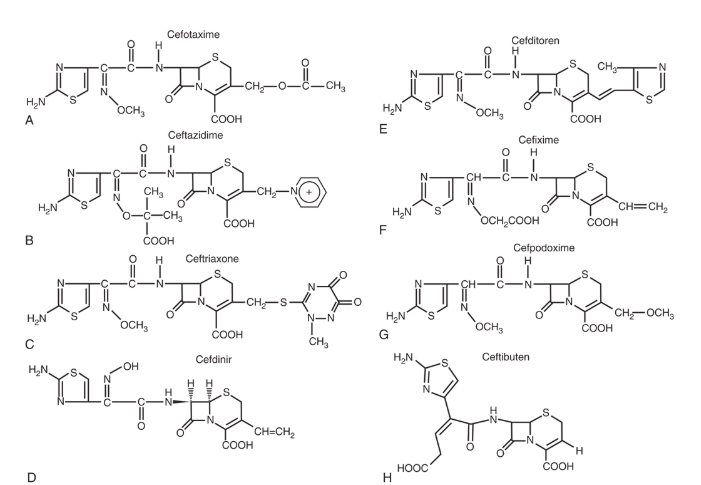
Third generation cephalosporins


Parenteral agents:

  • Ceftriaxone (once daily - long half-life)
  • Cefotaxime (CNS penetration)
  • Ceftazidime (Pseudomonas activity)

Oral agents:

  • Cefixime, Cefpodoxime, Cefdinir, Ceftibuten

Key features:

  • Significantly enhanced gram-negative coverage
  • Most penetrate CNS with inflamed meninges
  • Reduced gram-positive activity (except ceftriaxone)


Third generation: Ceftriaxone


Why Ceftriaxone is special

  • High protein binding (85-95%) → Dula renal and biliary elimination → Half-life: 6-9 hours → Once-daily dosing
  • Biliary excretion (40%) → No renal adjustment needed
  • Excellent CSF penetration
  • IM option available
  • Dosing debates: 1 gram Q24, 2 gram Q24, 2 gram Q12?…or 4 gram Q24? (OPAT)

Common uses:

  • Community-acquired pneumonia
  • Bacterial meningitis
  • Gonorrhea
  • Lyme disease

Third generation: Ceftazidime


Unique dpectrum

Ceftazidime has antipseudomonal activity BUT:

  • Poor gram-positive coverage (especially Streptococci)
  • Should NOT be used for streptococcal or staphylococcal infections

Best uses:

  • Pseudomonas infections
  • Nosocomial gram-negative infections
  • Febrile neutropenia (combination)

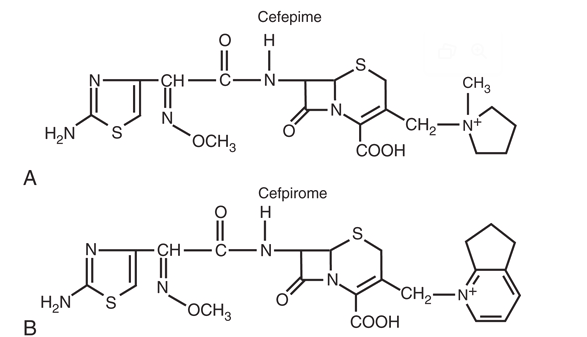
Fourth generation: Cefepime


Key advantages:

  • Zwitterionic structure → Rapid outer membrane penetration
  • Enhanced stability against AmpC β-lactamases
  • Maintains Pseudomonas activity
  • BETTER gram-positive coverage than ceftazidime
  • Good CNS penetration (also risk of neurotoxicity in renal impairment > 20–22 mg/L due to GABA-A antagonism)

Dosing: 1-2 g IV q8-12h

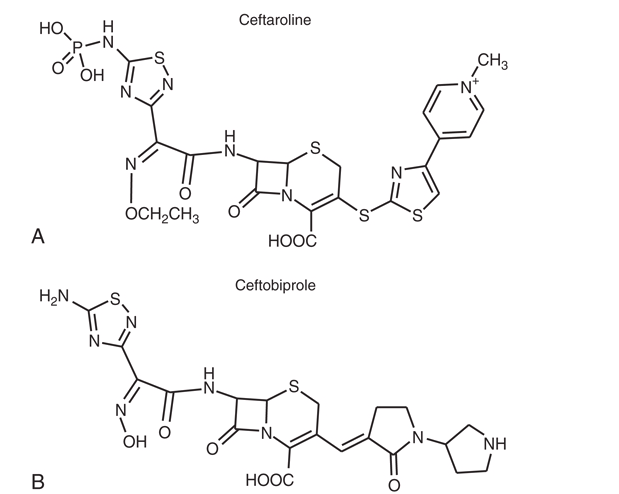
Fifth generation: Ceftaroline

FDA-approved indications:

  • Acute bacterial skin and skin structure infections (ABSSSI)
  • Community-acquired bacterial pneumonia (CABP)

Limitations:

  • NO activity against Pseudomonas
  • NO activity against ESBL-producers
  • Parenteral only (600 mg IV q12h)


Anti-MRSA Activity

Ceftaroline binds to PBP2A → Activity against MRSA


Generation comparison summary


Feature 1st Gen 2nd Gen 3rd Gen 4th Gen 5th Gen
MSSA ++++ +++ ++ +++ +++
MRSA - - - - ++++
Streptococcus ++++ +++ +++ +++ +++
Enterobacterales + ++ +++ ++++ ++
Pseudomonas - - +/- ++ -
Anaerobes - +/- +/- +/- -

β-Lactamase Inhibitor Combinations

Why combinations?


The problem: β-lactamase production

  • ESBLs: Hydrolyze 3rd generation cephalosporins
  • AmpC: Chromosomal or plasmid-mediated
  • Carbapenemases: KPC, MBL, OXA-48

The solution: β-lactamase inhibitors

  • Protect the cephalosporin from hydrolysis
  • Extend spectrum to resistant organisms

Ceftolozane-tazobactam


Structure: Novel cephalosporin + tazobactam

Key features:

  • Excellent activity against P. aeruginosa (including MDR)
  • Active against ESBL-producing Enterobacterales
  • Intrinsic AmpC stability

Limitations

NO activity against:

  • KPC-producing organisms
  • Metallo-β-lactamase (MBL) producers
  • OXA-48 producers

Dosing:

  • 1.5-3 g IV q8h

  • Extended infusion 3 g (over 3 h) q8h or LD 3 gram and 9 grams (over 24h) daily

Ceftazidime-avibactam


Structure: Ceftazidime + novel diazabicyclooctane inhibitor

Avibactam inhibits:

  • KPC (Class A carbapenemases)
  • OXA-48 (Class D)
  • AmpC (Class C)
  • ESBLs

Critical limitation

NO activity against MBL producers (NDM, VIM, IMP)

Avibactam does not inhibit metallo-β-lactamases

Dosing: 2.5 g IV q8h

Cefiderocol: Siderophore cephalosporin
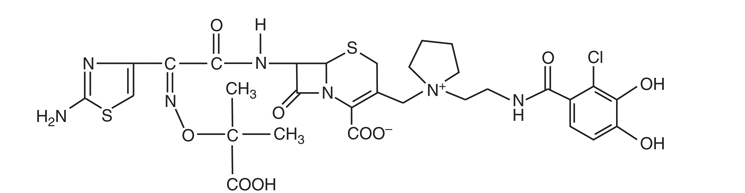

“Trojan Horse” Mechanism

  • Contains catechol moiety that binds iron
  • Hijacks bacterial iron transport systems
  • Delivers cephalosporin directly into cell

Unique spectrum:

  • Active against MBL-producers (NDM, VIM, IMP)
  • Acinetobacter baumannii complex
  • Stenotrophomonas maltophilia
  • Carbapenem-resistant Enterobacterales

Dosing: 2 g IV q8h (3-hour infusion)

BLI combination comparison


Feature Ceftolozane-Tazobactam Ceftaz-Avibactam Cefiderocol
MDR Pseudomonas ++++ ++ +++
ESBL +++ ++++ +++
KPC - ++++ +++
MBL - - ++++
OXA-48 - ++++ +++
Acinetobacter + + ++++

Pharmacokinetics

Oral bioavailability


Drug Bioavailability Food Effect
Cephalexin 90-100% Minimal
Cefadroxil 90-100% Minimal
Cefuroxime axetil 37-52% ↑ with food
Cefpodoxime ~50% ↑ with food
Cefixime 40-50% Minimal

Clinical pearl

Prodrug formulations (axetil, proxetil) should be taken with food!

Half-life and dosing intervals


Drug Half-Life Usual Interval
Cefazolin 1.5-2 h q8h
Cefuroxime 1-2 h q8h
Cefotaxime 1 h q6-8h
Ceftazidime 1.5-2 h q8h
Ceftriaxone 6-9 h q24h
Cefepime 2 h q8-12h

Renal elimination


Most cephalosporins: Primarily renal excretion

Exception: Ceftriaxone

  • 40% biliary excretion
  • No dose adjustment needed for renal impairment
  • Avoid in severe liver disease with renal impairment

Practical implications:

  • Dose adjust most cephalosporins in renal impairment
  • Check creatinine clearance before prescribing
  • Give supplemental doses after hemodialysis

CNS penetration


Cephalosporins with good CSF penetration (inflamed meninges):

  • Ceftriaxone: 10-20% of serum
  • Cefotaxime: 10-30% of serum
  • Ceftazidime: 20-40% of serum
  • Cefepime: 10-25% of serum

Poor CNS penetration:

  • Classic teaching: First-generation cephalosporins- However, modern studies show that high-dose cefazolin (e.g., IV every 8 hours or higher) achieves adequate CSF concentrations to treat susceptible Staphylococcus aureus
  • Second-generation cephalosporins

Adverse Effects

Adverse Effects

Overview of safety profile


Cephalosporins are generally well-tolerated


Most common adverse effects:

System Effects Frequency
GI Diarrhea, nausea 1-19%
Hypersensitivity Rash 1-3%
Hematologic Eosinophilia 1-10%
Renal Interstitial nephritis <1-5%

Penicillin cross-reactivity


The true risk

Historical quote of 10% cross-reactivity is WRONG

Actual IgE-mediated cross-reactivity: 1-2%

Key points:

  • Cross-reactivity related to R1 side chain similarity
  • 1st generation: Higher risk (similar side chains to aminopenicillins) but NOT cefazolin
  • 3rd/4th generation: Very low risk

Approach:

  • Assess penicillin allergy history carefully
  • Most patients can safely receive cephalosporins

Cephalosporin-specific concerns


Ceftriaxone: biliary sludge

  • Calcium-ceftriaxone precipitates in gallbladder
  • Occurs in 20-46% of patients
  • Usually asymptomatic
  • Resolves 10-60 days after stopping

Avoid: Mixing with calcium in neonates <28 days

CNS toxicity


Risk factors:

  • Renal impairment (decreased clearance)
  • High doses
  • Particularly with cefepime

Manifestations:

  • Encephalopathy
  • Myoclonus
  • Seizures

Cefepime neurotoxicity

Monitor for altered mental status in patients with renal impairment. Consider dose adjustment or alternative agent. TDM targets: keep troughs <10–15 mg/L, and definitely <20 mg/L

Hematologic effects


Coagulation abnormalities (MTT side chain):

  • Hypoprothrombinemia
  • Vitamin K antagonism
  • Affects: Cefotetan, Cefoperazone

Other hematologic effects:

  • Eosinophilia (1-10%)
  • Neutropenia (<1%, with prolonged use)
  • Positive Coombs test (3%)
  • Hemolytic anemia (rare)

Clinical Applications

Surgical prophylaxis


Cefazolin is first-line for:

  • Cardiac surgery
  • Vascular surgery
  • Orthopedic procedures (joint replacement, spine)
  • Head and neck surgery (with metronidazole)
  • Hysterectomy
  • Cesarean section
  • GI/biliary surgery (clean-contaminated)

Dosing: 2 g IV (3 g if >120 kg) within 60 min of incision

Community-acquired pneumonia


Inpatient, non-ICU:

  • Ceftriaxone 1-2 g IV q24h + Azithromycin
  • OR Respiratory fluoroquinolone monotherapy

Inpatient, ICU:

  • Ceftriaxone 2 g IV q24h + Azithromycin
  • OR Ceftriaxone + Respiratory fluoroquinolone

Bacterial meningitis


Empiric therapy:

  • Ceftriaxone 2 g IV q12h (or Cefotaxime 2 g IV q4-6h)
  • PLUS Vancomycin (for resistant S. pneumoniae)
  • ± Ampicillin (if Listeria risk)

Critical point

3rd generation cephalosporins penetrate CSF well with inflamed meninges but are NOT effective against Listeria!

Hospital-acquired pneumonia


Antipseudomonal cephalosporin options:

  • Cefepime 2 g IV q8h
  • Ceftazidime 2 g IV q8h
  • Ceftolozane-tazobactam 3 g IV q8h

Add coverage based on risk factors:

  • MRSA risk → Add vancomycin or linezolid
  • MDR risk → Consider combination therapy

Intra-abdominal infections


Community-acquired:

  • Ceftriaxone + Metronidazole
  • Cefoxitin or Cefotetan alone (mild-moderate)

Healthcare-associated/Resistant pathogens:

  • Ceftolozane-tazobactam + Metronidazole
  • Ceftazidime-avibactam + Metronidazole
  • Cefepime + Metronidazole

Urinary tract infections


Uncomplicated cystitis:

  • Cephalexin 500 mg PO q6h (alternative agent)
  • Not first-line due to collateral damage concerns

Complicated UTI/Pyelonephritis:

  • Ceftriaxone 1 g IV q24h
  • Cefepime 1 g IV q8h
  • Ceftolozane-tazobactam 1.5 g IV q8h
  • Ceftazidime-avibactam 2.5 g IV q8h

Antimicrobial Resistance

β-Lactamase classification


Class Type Examples Inhibited by Avibactam?
A Serine ESBLs, KPC Yes
B Metallo (MBL) NDM, VIM, IMP No
C AmpC Chromosomal, CMY Yes
D OXA OXA-48 Yes


Key point

Metallo-β-lactamases (Class B) are NOT inhibited by avibactam or tazobactam. Only cefiderocol maintains activity.

ESBL-producing organisms


Extended-Spectrum β-Lactamases (ESBLs):

  • Hydrolyze 3rd generation cephalosporins
  • Common types: CTX-M, SHV, TEM variants
  • Often co-resistant to fluoroquinolones

Treatment options:

  • Carbapenems (traditional)
  • Ceftolozane-tazobactam
  • Ceftazidime-avibactam

Carbapenem-resistant enterobacterales (CRE)


Mechanism determines treatment:

Mechanism Agent of Choice
KPC Ceftazidime-avibactam
OXA-48 Ceftazidime-avibactam
MBL (NDM, VIM) Cefiderocol

Clinical pearl

Know your local epidemiology! KPC predominates in some regions, MBL in others.

AmpC β-Lactamases


“SPACE” organisms with inducible AmpC:

  • Serratia
  • Pseudomonas
  • Acinetobacter
  • Citrobacter (freundii)
  • Enterobacter

“HECK-Yes” organisms with inducible AmpC

  • Hafnia alvei - Enterobacter cloacae

  • Citrobacter freundii - Klebsiella aerogenes

  • Yersinia enterocolitica

  • Enterbacter species

  • Serratia marcescens

Preferred agents:

  • Cefepime (stable to AmpC)
  • Ceftazidime-avibactam
  • Carbapenems

Special Considerations

Pregnancy and lactation


Pregnancy category: Most cephalosporins are Category B

  • No evidence of teratogenicity
  • Cross placenta
  • Used routinely in obstetric practice

Lactation:

  • Excreted in small amounts in breast milk
  • Generally considered compatible with breastfeeding

Pediatric dosing principles


Weight-based dosing (mg/kg/day):

Drug Mild-Moderate Severe
Cefazolin 25-50 mg/kg divided q8h 100-150 mg/kg divided q6-8h
Ceftriaxone 50-75 mg/kg/dose q24h 80-100 mg/kg/day divided q12-24h
Cefepime 50 mg/kg q12h 50 mg/kg q8h


Maximum doses: Generally do not exceed adult doses

Prolonged infusion strategies


Rationale: Optimize T>MIC (time-dependent killing)

Options:

  • Extended infusion: 3-4 hour infusion
  • Continuous infusion: 24-hour infusion (requires stability data for antibiotic)

Best evidence for:

  • Cefepime
  • Ceftazidime
  • Seriously ill patients / ICU

Summary

Key takeaways (Part 1)


  1. Structure: β-lactam ring + dihydrothiazine ring; R1 affects spectrum, R2 affects pharmacology
  2. Mechanism: Inhibit PBPs → prevent cell wall synthesis → bactericidal
  3. Pharmacodynamics: Time-dependent killing (optimize T>MIC)
  4. Generations: 1st (GP), 2nd (some GN/anaerobes), 3rd (GN/CNS), 4th (broad), 5th (MRSA)

Key takeaways (Part 2)


  1. Cefazolin: First-line for surgical prophylaxis
  2. Ceftriaxone: Once daily, no renal adjustment, CNS penetration
  3. BLI combinations: Match to resistance mechanism (KPC → Ceftaz-avi; MBL → Cefiderocol)
  4. Cross-reactivity: True rate ~1-2%; consider specific side chains

Clinical decision-making


Bottom line

Cephalosporins remain essential antibiotics. Selection should be based on:

  • Likely pathogens
  • Local resistance patterns
  • Site of infection
  • Patient-specific factors (allergies, renal function)
  • Available formulations (PO vs IV)

Key resources


Guidelines:

  • IDSA Practice Guidelines (various infections)
  • Sanford Guide to Antimicrobial Therapy

Clinical Pearls to Remember:

  1. Cefazolin = surgical prophylaxis gold standard
  2. Ceftriaxone = the versatile 3rd generation agent
  3. Check local resistance patterns before empiric therapy
  4. Know your β-lactamases!
  5. Most “penicillin allergies” allow cephalosporin use

Appendix: Reference Tables

Dosing quick reference


Drug Route Usual Adult Dose
Cefazolin IV 1-2 g q8h
Cephalexin PO 500 mg q6h
Cefuroxime IV 0.75-1.5 g q8h
Ceftriaxone IV/IM 1-2 g q24h
Ceftazidime IV 1-2 g q8h
Cefepime IV 1-2 g q8-12h
Ceftaroline IV 600 mg q12h
Ceftolozane-tazo IV 1.5-3 g q8h
Ceftazidime-avi IV 2.5 g q8h
Cefiderocol IV 2 g q8h

Generation-at-a-glance


Generation Prototype Key Feature
1st Cefazolin Gram-positive; prophylaxis
2nd Cefuroxime Enhanced GN; cephamycins for anaerobes
3rd Ceftriaxone Broad GN; CNS penetration
4th Cefepime Broad spectrum; Pseudomonas
5th Ceftaroline MRSA activity
BLI Various Overcomes β-lactamases